
Ohio State Holds the Crown, Miami Sets the Pace, and Two Receivers Cross 1,000 Yards
November 3, 2026 | Receiver Institute — Wideout University
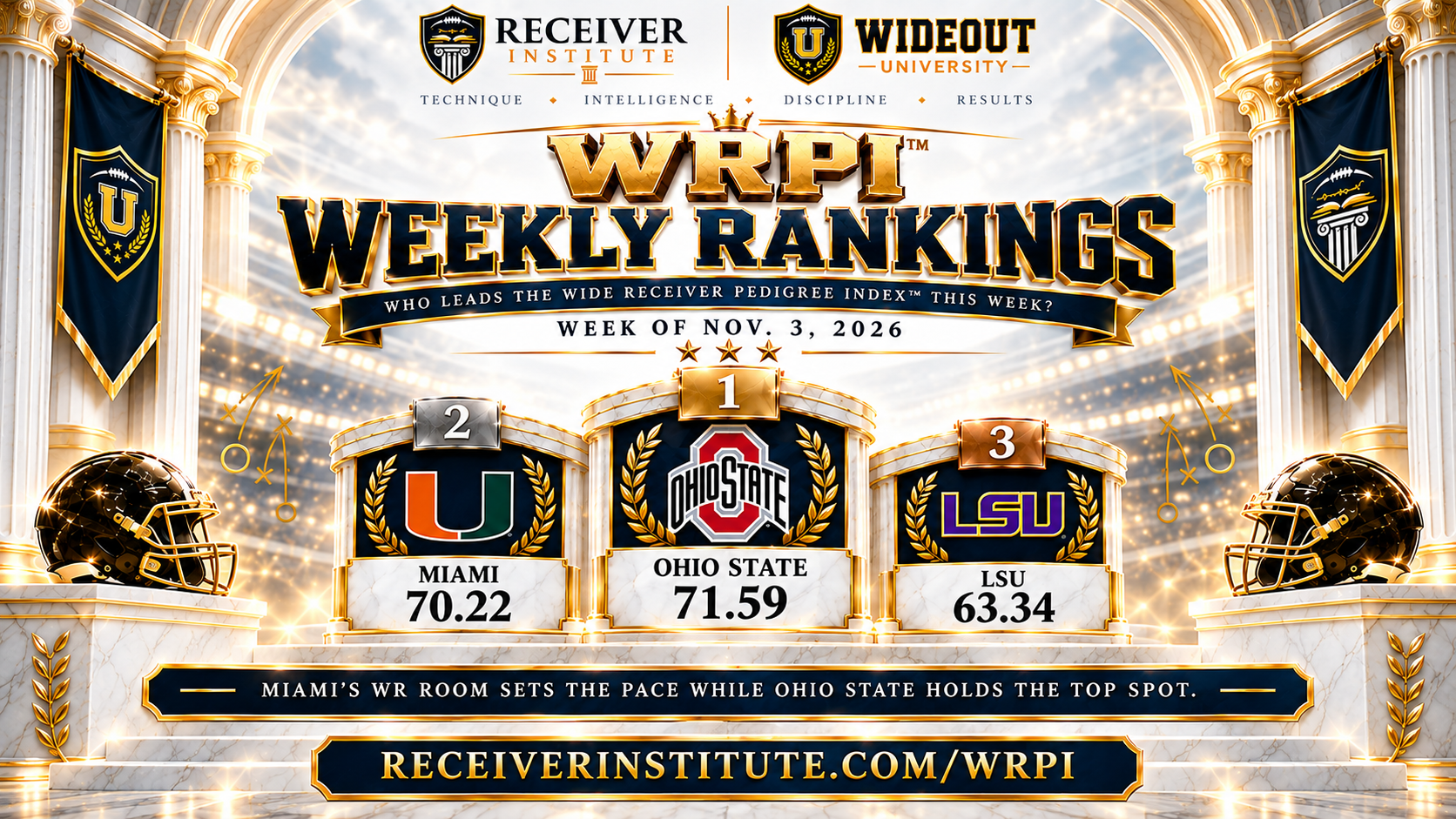
Just 1.37 points separate the nation's top two programs in the Wide Receiver Pedigree Index's ten-school field. Meanwhile, LSU strengthens its position at No. 3, Alabama climbs the rankings, and two of college football's premier receivers reach major milestones.
The race for Wide Receiver University is becoming a battle between two very different definitions of greatness.
Ohio State remains No. 1 in the latest Wide Receiver Pedigree Index (WRPI) rankings, holding a narrow 71.59-to-70.22 advantage over Miami.
But look beyond the overall scores, and another story emerges.
Miami has the most productive current receiving room in the WRPI field, leading all ten programs in receptions, receiving yards, and touchdowns. The Hurricanes are putting together a remarkable season, powered by Malachi Toney and a collection of emerging contributors.
Ohio State, meanwhile, continues to demonstrate why receiver pedigree is about more than one season. The Buckeyes combine their current production with an extraordinary pipeline of NFL talent.
One program leads the present. The other leads the overall pedigree.
And the competition is far from settled.
Miami's Receiving Room Sets the Standard
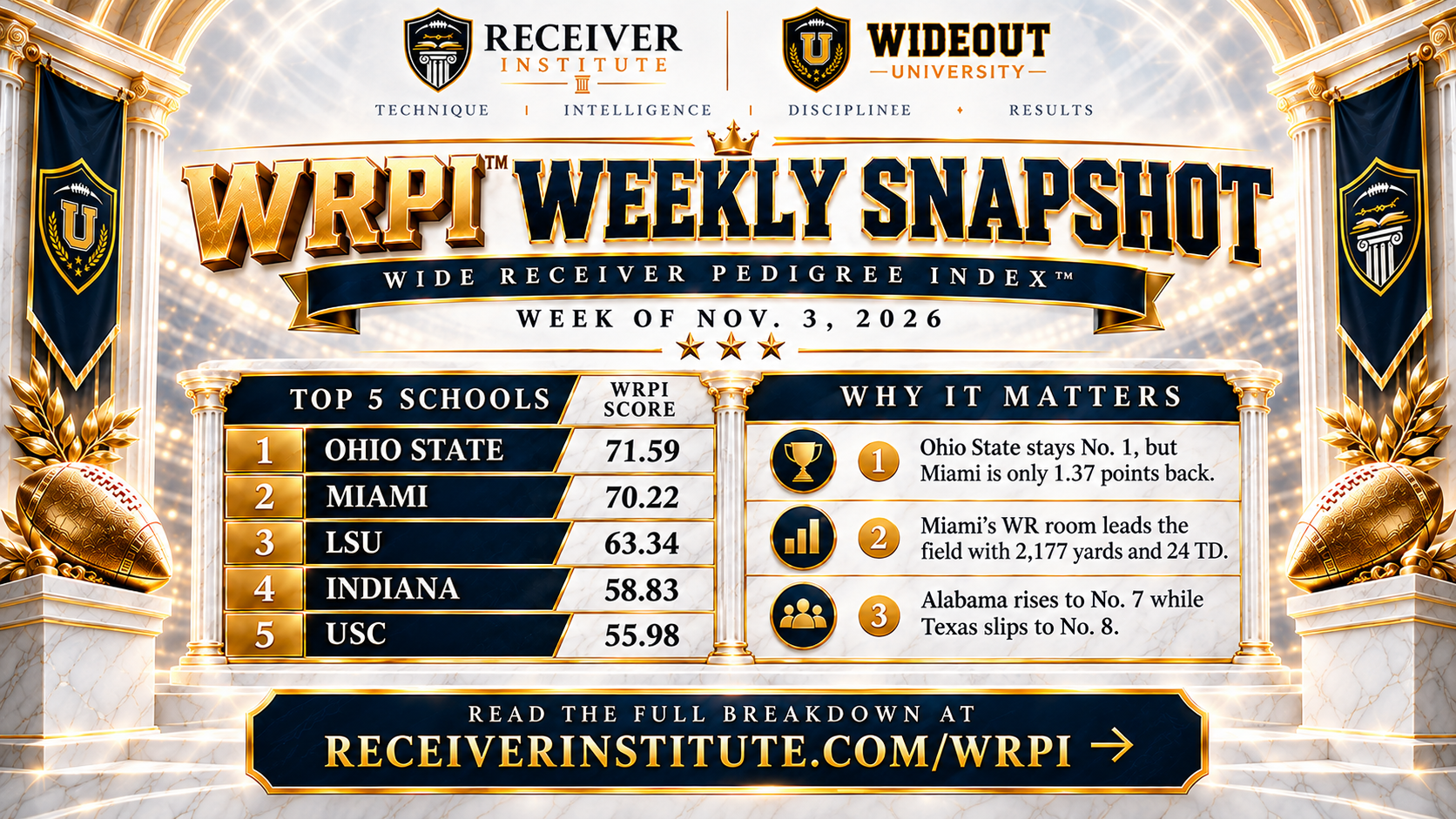
Through eight games, Miami's wide receivers have produced:
159 receptions
2,177 receiving yards
24 receiving touchdowns
No other program in the WRPI's ten-school field matches those totals.
Miami's current receiving room also holds the highest college-room component score in the rankings, even though Ohio State retains the overall lead.
The centerpiece of Miami's success is Malachi Toney.
The Hurricanes' standout receiver officially crossed the 1,000-yard threshold this week, bringing his season totals to 73 receptions, 1,027 yards, and 13 touchdowns.
In Miami's latest game, Toney contributed seven receptions, 75 yards, and two touchdowns, extending an already exceptional campaign.
But Miami's performance goes beyond one star.
Cooper Barkate has contributed 372 receiving yards and four touchdowns, while Daylyn Upshaw has added 263 yards and two scores. Together with the rest of the receiving room, they've built an offense demonstrating both high-end production and meaningful depth.
That's an important distinction within the WRPI methodology.
The index doesn't simply reward whichever program has the best individual receiver. It evaluates the productivity and depth of the entire college receiving room.
Right now, Miami is setting that standard.
Jeremiah Smith Answers With His Own 1,000-Yard Milestone
Not to be outdone, Ohio State's Jeremiah Smith has joined Toney in the 1,000-yard club.
Smith's updated season numbers are remarkable:
62 receptions | 1,067 yards | 13 touchdowns
Smith recorded another 10 receptions for 83 yards and a touchdown in Ohio State's matchup against USC.
His season totals now exceed Toney's in receiving yards, while the two are tied with 13 receiving touchdowns.
That individual rivalry is becoming one of the most compelling storylines within the WRPI.
Two elite receivers. Two programs competing for the top ranking. Two different paths to the title of Wide Receiver University.
And neither has shown much interest in slowing down.
The Professional Pipeline Keeps Ohio State on Top
The WRPI isn't designed to identify only the most productive college receiving room.
It's designed to evaluate the complete receiver pedigree of a university, from current college production to NFL performance and historical legacy.
That's where Ohio State continues to distinguish itself.
Jaxon Smith-Njigba is having an extraordinary NFL season, and his latest performance has pushed him to:
64 receptions | 985 receiving yards | 9 touchdowns
Smith-Njigba's 985 receiving yards lead the NFL alumni tracked in the WRPI dataset.
He's also approaching the 1,000-yard threshold himself.
And he's hardly alone.
Ohio State's active NFL receiver pipeline includes Chris Olave, Garrett Wilson, Emeka Egbuka, Marvin Harrison Jr., and others.
The combined accomplishments of those players help explain why Ohio State remains No. 1 despite Miami's superior current-room production.
The question is becoming increasingly interesting:
Can Miami's current receiving dominance eventually overcome Ohio State's professional pedigree?
The Updated WRPI Top 10
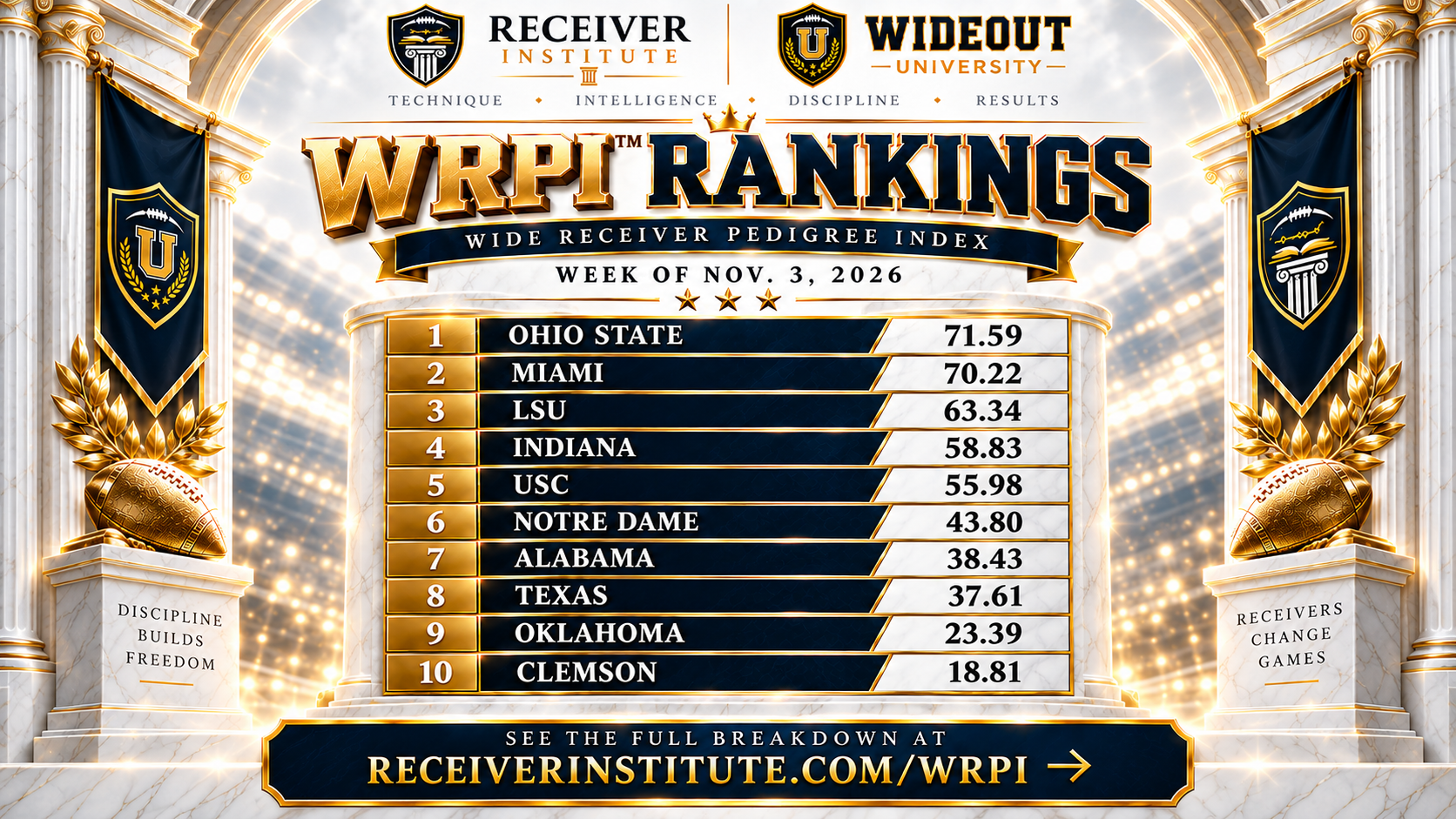
RankUniversityWRPI ScoreMovement1Ohio State71.59—2Miami70.22—3LSU63.34—4Indiana58.83—5USC55.98—6Notre Dame43.80—7Alabama38.43↑ 18Texas37.61↓ 19Oklahoma23.39—10Clemson18.81—
Provisional WRPI rankings for the week of November 3, 2026.
Only two programs changed positions this week, but the relatively stable order doesn't tell the entire story.
Alabama Climbs, Texas Slips, and LSU Holds Third
Alabama makes this week's only upward move, climbing from eighth to seventh.
The Crimson Tide's WRPI improved from 37.08 to 38.43, while Texas dropped from 41.30 to 37.61.
Meanwhile, LSU strengthened its hold on third place.
The Tigers' provisional WRPI rose from 61.14 to 63.34, despite having a bye week.
How can a school's score improve without playing?
It's an important feature of the current WRPI methodology.
The college component evaluates performance relative to the other programs in the field. As teams play additional games, their per-game production and relative percentile rankings change. Consequently, a school can gain or lose points even during a bye week.
For LSU, the latest recalculation improved its standing within the current comparison group.
That doesn't mean LSU recorded additional receiving production this week. It means the other programs' updated performances changed the comparison.
As the WRPI evolves, that distinction will remain important for interpreting weekly movement.
USC's Trent Mosley Makes His Statement
Perhaps the most interesting individual performance of the week came from USC's Trent Mosley.
Facing the top-ranked program in the WRPI, Mosley delivered:
5 receptions | 101 yards | 1 touchdown
His performance helped USC defeat Ohio State and added another 100-yard receiving performance to the Trojans' season.
Mosley's season totals now stand at 32 receptions, 512 yards, and six touchdowns.
While USC remains fifth in the WRPI standings, Mosley's performance is a reminder that overall pedigree rankings and individual game results measure different things.
Ohio State may own the strongest overall receiver profile, but that doesn't mean another program's receivers can't win the matchup on any given Saturday.
That's part of what makes the competition so compelling.
Five Pace-Setters and Milestones
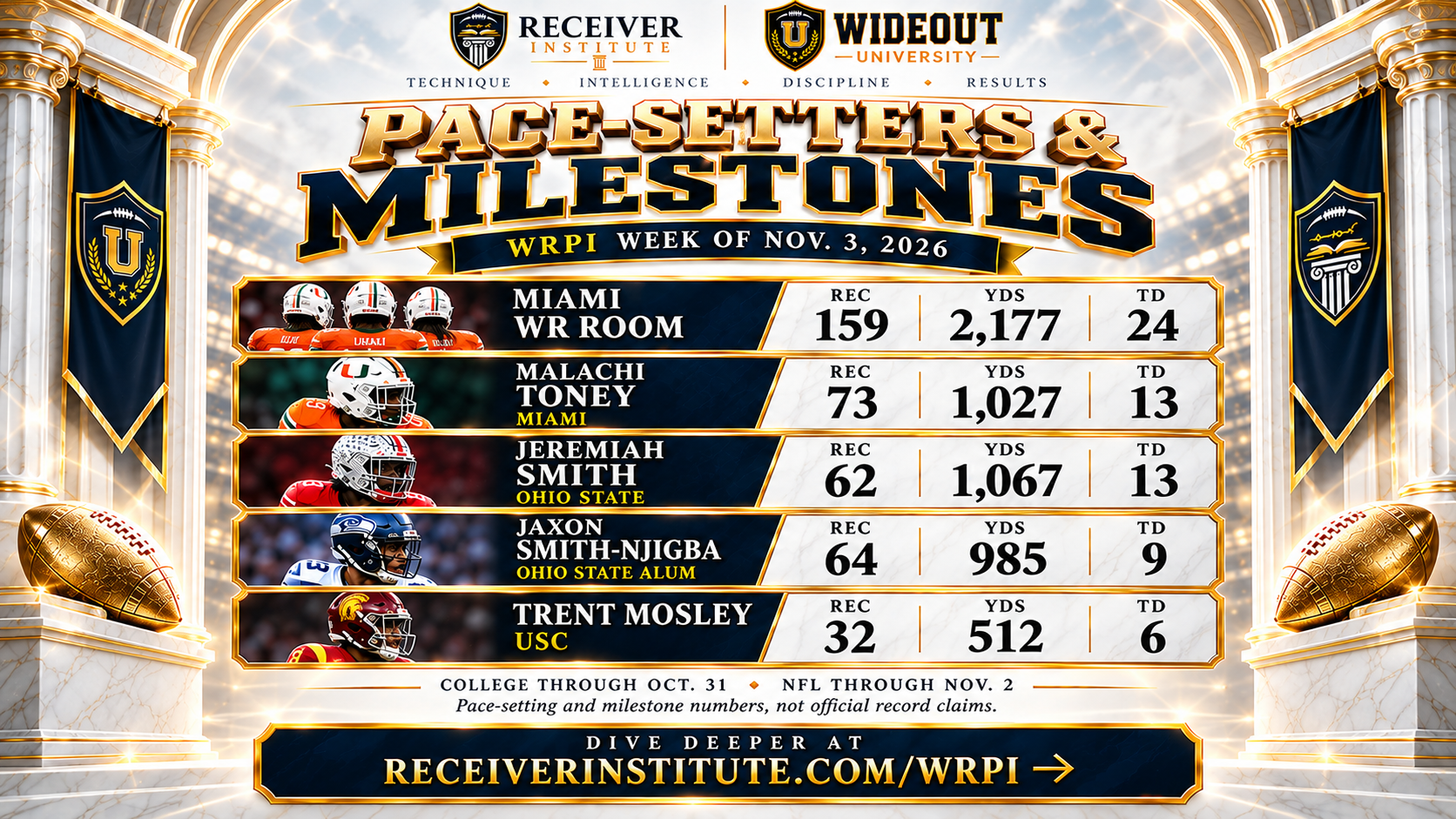
This week's featured WRPI achievements reflect both individual excellence and program-wide production.
Miami WR Room — The College Production Leader
159 receptions, 2,177 receiving yards, and 24 touchdowns. Miami continues setting the standard for current receiving-room production.
Malachi Toney — The 1,000-Yard Breakthrough
73 receptions, 1,027 yards, and 13 touchdowns. Toney joins college football's 1,000-yard receivers while leading Miami's charge toward the top.
Jeremiah Smith — Another 1,000-Yard Star
62 receptions, 1,067 yards, and 13 touchdowns. Smith continues strengthening Ohio State's current receiving profile.
Jaxon Smith-Njigba — NFL Excellence
64 receptions, 985 yards, and nine touchdowns. The Ohio State alumnus continues demonstrating the professional success that makes the Buckeyes' receiving pedigree so formidable.
Trent Mosley — The Statement Performance
32 receptions, 512 yards, and six touchdowns on the season, highlighted by a 101-yard performance against Ohio State.
Together, these achievements illustrate why Wide Receiver University is more than a debate about one player or one season.
What Exactly Does the WRPI Measure?
The Wide Receiver Pedigree Index is Receiver Institute's analytical framework for evaluating the strength of college football receiving programs.
Rather than relying exclusively on NFL Draft selections, historical reputation, or individual stars, the index combines four dimensions:
Current WR Room: The largest component, evaluating receiving production, top-end excellence, depth, game impact, and recognition.
NFL Alumni Performance: Evaluating the performance of active NFL receivers through a multiplier applied to a school's college production and draft bonus.
Historical First-Round Draft Picks: Rewarding programs for producing receivers selected at the highest level of the NFL Draft.
Legacy Contributions: Recognizing the historical accomplishments of retired receiving alumni.
The result is a dynamic measure of receiving talent, production, and development across multiple levels of football.
The current rankings represent an initial ten-school comparison, not an exhaustive ranking of every FBS program.
Future editions will expand the field.
The WRU Debate Is Only Getting Better
Ohio State is still No. 1.
Miami is still right behind.
LSU has solidified its place among the top three, Alabama is gaining ground, and the individual achievements continue piling up.
Most importantly, the debate is evolving beyond reputation.
We can now ask more specific questions:
Who has the best receiving room today? Which programs consistently develop NFL talent? Which schools produce the greatest depth? And whose receiving legacy is strongest across generations?
Those aren't necessarily the same university.
And that's exactly why the Wide Receiver Pedigree Index exists.
Explore the complete WRPI rankings, current receiver profiles, NFL alumni performance, and scoring methodology:
RECEIVERINSTITUTE.COM/WRPI
Who deserves the WRU crown—and which university should join the next WRPI expansion?
Receiver Institute | Technique. Intelligence. Discipline. Results.
Data and methodology note: College receiving statistics are current through October 31, 2026; tracked NFL alumni receiving totals are through November 2, 2026. The November 3 WRPI rankings are provisional because the league-wide NFL performance multiplier continues to use its October 19 benchmark. The current college scoring methodology also evaluates relative performance within the initial ten-school field. Final rankings may change following full NFL benchmark validation.