Introducing the Wide Receiver Pedigree Index (WRPI)™️
The Wide Receiver Pedigree Index™ is a new way to measure college football's best receiver programs—combining current production, NFL success, draft history, and legendary alumni into one score.
By Receiver Institute | October 15, 2026
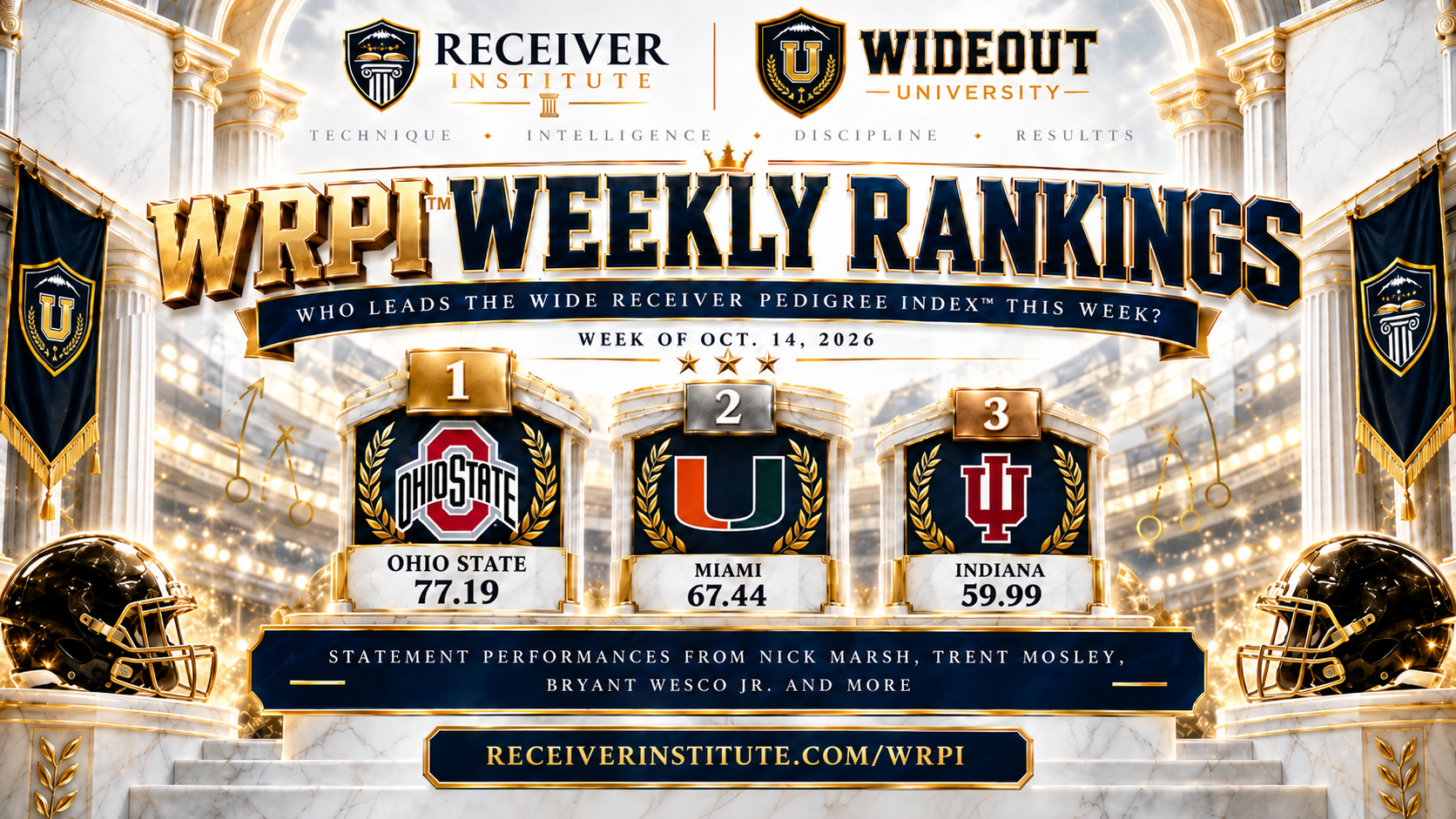
The inaugural WRPI™ rankings begin with ten programs and one question: Who is developing the best wide receivers in football?
Everybody Claims Wide Receiver U. Now There's a Scoreboard.
Every college football fan knows the argument.
Which school is the real Wide Receiver U? Here at Receiver Institute, we call it Wideout University.
Ohio State fans can point to an extraordinary pipeline of NFL talent. LSU supporters have a seemingly endless collection of professional stars. Alabama, USC, Clemson, Miami and others have decades of history to defend their claims.
And every season, another program enters the conversation on the strength of its newest breakout receivers.
The debate has traditionally been settled—or, more accurately, never settled—through a familiar collection of evidence.
NFL Draft picks. Pro Bowl selections. Hall of Famers. Current stars. Championship seasons. Viral highlights.
They're all legitimate considerations.
But there's a fundamental question underneath the argument that deserves more attention:
What makes a school great at developing wide receivers?
Is it enough to have produced an all-time great 25 years ago? Should a program receive permanent recognition because it once sent several receivers into the first round? What about a school producing an exceptional receiver room today but without the decades of NFL history to compete with established powers?
At Receiver Institute, we believe the answer requires looking at the entire development pipeline.
Not just where receivers finish.
Where they start, how they develop, what they accomplish, and what happens after they leave.
That's why we created the Wide Receiver Pedigree Index™ (WRPI™).
Introducing the WRPI™
The WRPI™ is a data-driven ranking system developed by Receiver Institute's Wideout University initiative to evaluate the strength of college football's wide receiver programs.
Its central philosophy is straightforward:
The best receiver programs don't simply produce great players. They consistently develop them.
That distinction matters.
A program's history deserves recognition. So does its ability to prepare players for the NFL. But the most important evidence of its current development environment should come from the receivers wearing that school's uniform today.
For that reason, current college receiver performance carries the greatest weight in the WRPI™.
NFL success strengthens a school's case. Draft pedigree adds value. Historic greatness contributes to the overall profile.
Everything has its place.
No single legendary alumnus should guarantee a school the top spot forever. Likewise, one exceptional season shouldn't automatically erase decades of demonstrated development.
The WRPI™ is designed to respect both.
Ten Schools. One Starting Point.
Before we go any further, one important distinction:
These are not the ten best wide receiver programs in the country as determined by a nationwide evaluation.
They're the ten programs selected for our inaugural pilot—an initial group representing prominent and emerging participants in the Wideout University conversation.
Our starting field consists of Ohio State, Miami, Indiana, USC, LSU, Alabama, Texas, Notre Dame, Clemson and Oklahoma.
There are compelling cases for programs outside this group. Their absence isn't a statement about their worthiness.
This is a starting point, not the final word.
By beginning with ten schools, we're able to test the methodology, examine the underlying data, establish an initial benchmark, and invite the football community into the process.
Our intention is to expand the conversation and the comparison pool over time.
For now, these are the programs in the inaugural WRPI™.
The inaugural rankings
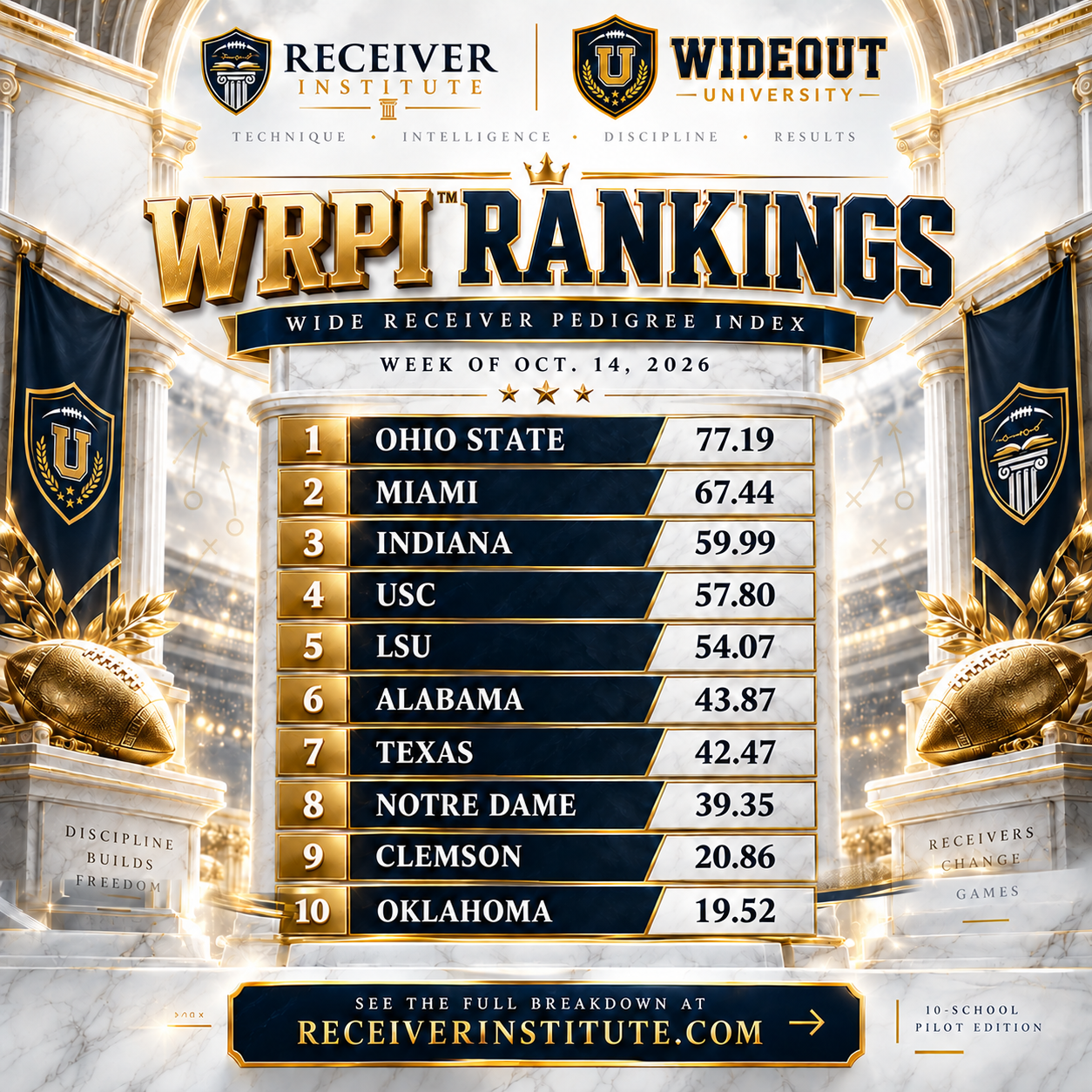
The inaugural ten-school WRPI™ leaderboard, reflecting college games through October 10, NFL performances through October 12, and updated roster information through October 14, 2026.
Ohio State opens at No. 1 with a WRPI™ score of 77.19, followed by Miami at 67.44 and Indiana at 59.99.
USC (57.80) and LSU (54.07) complete the top five.
Alabama (43.87), Texas (42.47), Notre Dame (39.35), Clemson (20.86) and Oklahoma (19.52) round out the inaugural field.
Remember: these scores reflect comparisons among the ten pilot schools. They aren't national rankings, and a lower score in this edition shouldn't be interpreted as a permanent judgment on a program's history.
The rankings represent a snapshot of where these programs stand under the inaugural scoring model.
And that model starts where we believe the conversation should start: the current receiver room.
How the WRPI™ Works
We didn't want the WRPI™ to become another subjective list based on recognizable names or program reputation.
We wanted a consistent, transparent framework with a defensible scoring system.
The WRPI™ has four primary components:
College Receiver Performance. Draft Pedigree. Current NFL Alumni Performance. Legacy Achievements.
The formula is:
WRPI™ = (College Score + Draft Pedigree) × NFL Alumni Multiplier + Legacy Points
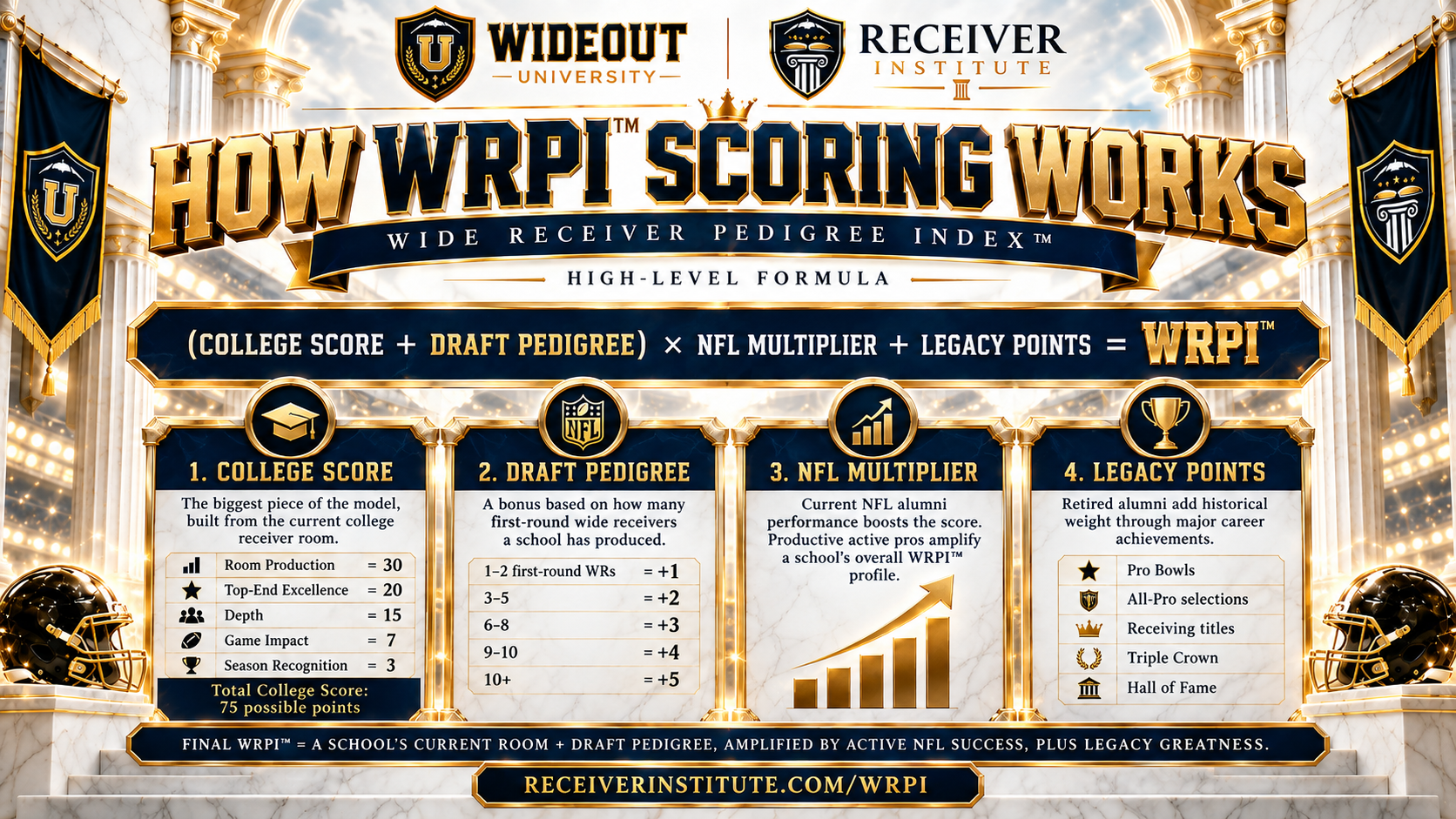
A breakdown of the four components behind the Wide Receiver Pedigree Index™.
1. The Current Receiver Room — Up to 75 Points
This is the foundation of the WRPI™.
We evaluate current wide receivers using five categories:
Room Production (30 points): Total receiving output, including yards, receptions and touchdowns.
Top-End Excellence (20 points): How productive is the program's leading receiver?
Depth (15 points): How much meaningful production comes from the receivers behind the No. 1 option?
Game Impact (7 points): How consistently are receivers producing standout individual performances?
Season Recognition (3 points): Recognition through designated national postseason honors.
These categories reward more than having one exceptional talent.
An outstanding WR1 matters. But so does developing productive second, third and fourth options.
A school shouldn't be able to rely entirely on a superstar while the rest of its receiver room contributes little.
Likewise, a deep and balanced group should receive recognition even without one player dominating national headlines.
This is where we believe the WRPI™ has an opportunity to change the conversation.
2. NFL Draft Pedigree — Up to 5 Points
First-round NFL Draft selections matter.
They represent a meaningful indicator of a college program's ability to produce players recognized as elite professional prospects.
But draft position is not the same as professional achievement, and it isn't a complete measure of college development.
That's why first-round WR selections* contribute a relatively modest bonus, capped at five points.
Draft pedigree strengthens a program's profile without becoming the primary determinant.
*For the inaugural scoring model, only first round picks are included. It is possible that future scoring models will weight later round draft picks as well.
3. Current NFL Alumni — Up to a 1.15× Multiplier
What happens after a receiver leaves college?
An effective developmental program should prepare its players to produce beyond campus.
The WRPI™ measures the performance of current NFL alumni and uses that production to amplify the school's college and draft score.
The multiplier ranges from 1.00× to 1.15×.
This is intentionally different from simply adding points for the number of NFL players a school has produced.
NFL affiliation alone does not earn a school performance credit. Productive professional receivers are what move the multiplier.
The distinction is important: getting drafted and performing in the league are different accomplishments.
Both deserve recognition, but they shouldn't be treated as interchangeable.
4. Legacy Achievements — Up to 8 Points
History matters.
Randy Moss, Jerry Rice, Calvin Johnson, Marvin Harrison, and generations of other great receivers helped establish the standards today's players pursue.
A school's ability to produce players who become legends of the game deserves acknowledgment.
The WRPI™ awards legacy credit for qualifying accomplishments by retired NFL alumni, including Pro Bowl selections, All-Pro honors, receiving titles, Triple Crowns, and Pro Football Hall of Fame recognition.
But those achievements do not outweigh what an entire current receiver room is doing on Saturdays.
We want history to inform the rankings, not permanently determine them.
That's the balance we're pursuing.
What the First Rankings Tell Us
The inaugural results already offer some compelling storylines.
Ohio State: Excellence Across the Pipeline
Ohio State begins this edition atop the rankings for good reason.
Through six games, its wide receivers have combined for 93 receptions, 1,669 receiving yards and 16 receiving touchdowns.
Jeremiah Smith leads the way with 48 receptions, 916 yards and 11 touchdowns.
But the Buckeyes' WRPI™ profile extends far beyond Smith.
Their current room is producing. Their draft pedigree is substantial. And their current NFL alumni provide one of the strongest professional multipliers in this initial group.
It's exactly the type of performance across multiple stages of development that the WRPI™ was built to recognize.
Miami: The Current Room Demands Respect
Miami checks in at No. 2, illustrating why the WRPI™ cannot be exclusively a historical exercise.
Malachi Toney has accumulated 39 receptions, 604 yards and six touchdowns, helping power one of the strongest current receiver-room scores in the pilot.
The Hurricanes don't need the largest group of currently productive NFL alumni to make a compelling case.
Their players are making it on the field right now.
And that's worth a great deal in our model.
Indiana: A Reason to Rethink the Conversation
Perhaps the most interesting result of the first rankings is Indiana at No. 3.
Charlie Becker and Nick Marsh have combined for 1,057 receiving yards and 14 touchdowns through six games.
Marsh's latest performance against Nebraska—six receptions, 187 yards and two touchdowns—was one of the outstanding individual outings represented in this edition.
Indiana's position illustrates a critical point about the WRPI™:
A program shouldn't need generations of name recognition to enter the Wideout University conversation.
If its current receivers are producing at an exceptional level, the rankings should reflect that.
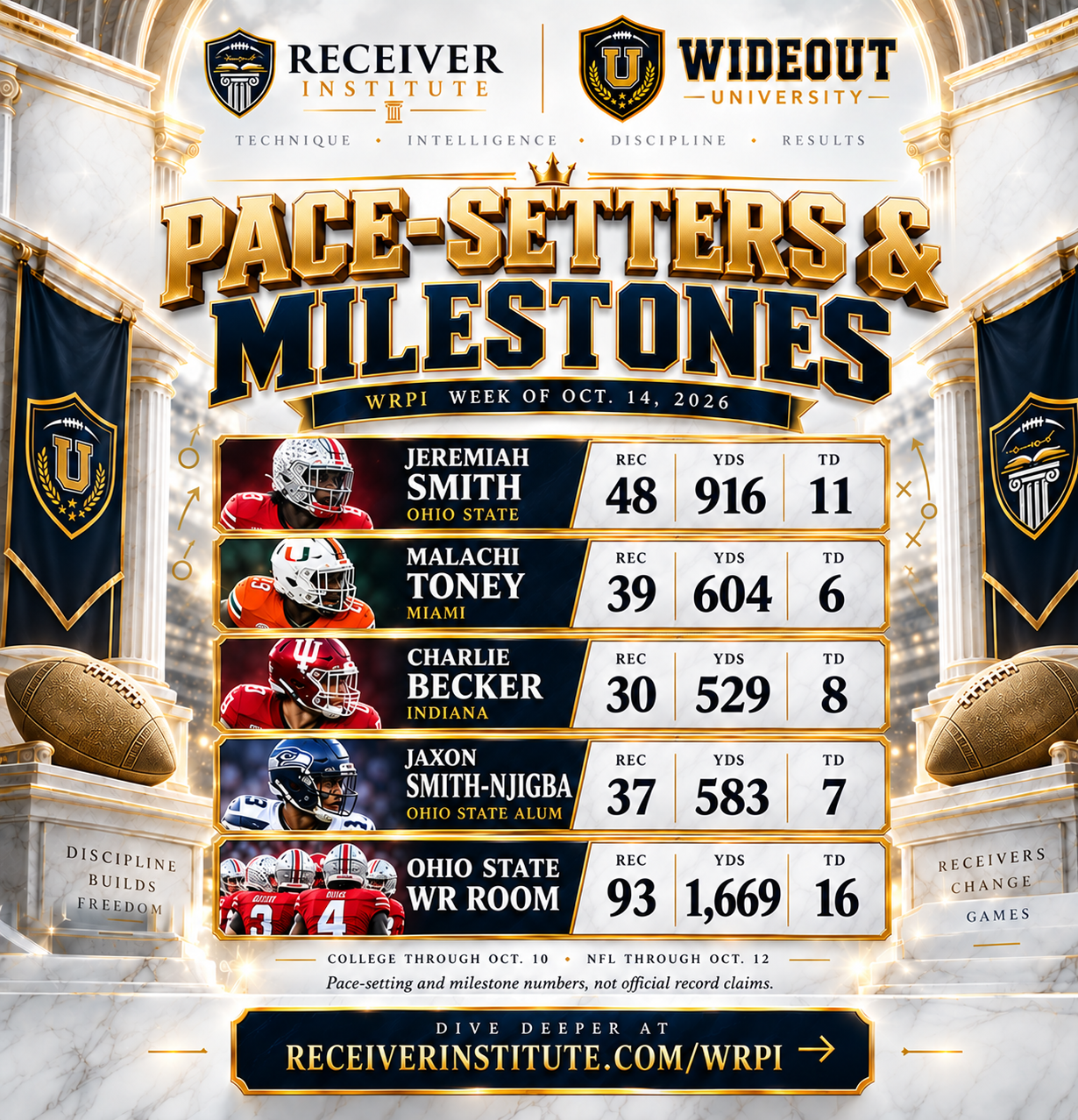
The current college and NFL alumni performances helping shape the inaugural rankings. Figures reflect season-to-date totals, not claims of newly broken records.
The Performances Behind the Numbers
While the overall WRPI™ measures programs, individual receivers ultimately drive the results.
And every week offers another opportunity for those players to make their mark.
In the latest completed games for each program, several performances stood out.
Indiana's Nick Marsh delivered 187 yards and two touchdowns against Nebraska.
USC's Trent Mosley contributed nine receptions, 111 yards and a touchdown against Penn State.
Texas receiver Cam Coleman produced 110 yards and a touchdown against Oklahoma.
Ohio State's Jeremiah Smith continued his outstanding campaign with 93 yards and two touchdowns against Maryland.
Clemson's Bryant Wesco Jr. recorded nine receptions for 152 yards in the Tigers' most recent game against Miami.
These performances don't all come from the same calendar weekend; Miami and Clemson, for example, did not play on October 10. We're using each program's latest completed game for this initial presentation.
Each outing tells a different story about individual development, opportunity and production.
And each helps shape a much larger picture of what these programs are building.
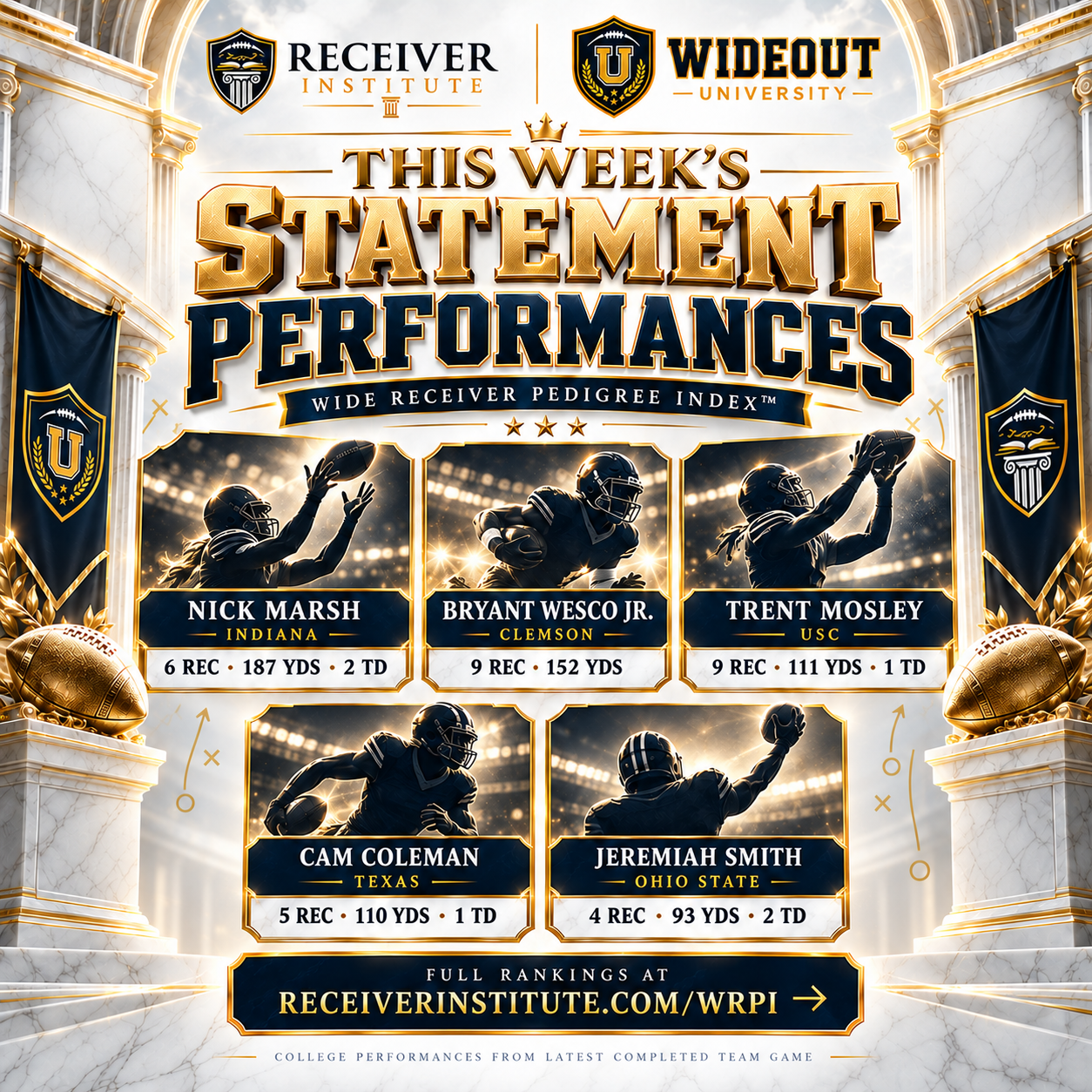
Five notable receiving performances from the latest completed games among the inaugural WRPI™ programs.
What Makes a Great Receiver Program?
This is the larger question we hope the WRPI™ helps answer.
Consider two hypothetical programs.
One has produced numerous NFL stars and Hall of Fame-caliber players, but its current receiver room is struggling to generate production.
The other lacks the same historical reputation, but its present receivers are thriving, demonstrating depth, and consistently making significant contributions.
Which is Wideout University?
There's no universal answer.
But an evaluation that considers only historical accomplishments would give the second program little opportunity to compete.
And an evaluation that looks only at current college statistics would ignore years of demonstrated development.
Neither captures the full picture.
Our position is that greatness should be measured across the entire receiver lifecycle.
From recruiting and development to college production, NFL transition, professional performance, and ultimately historical significance.
It's also why no single WRPI™ ranking should be treated as permanent.
A school's score can change as its receivers improve, NFL alumni produce, new players are drafted, and careers eventually enter the historical record.
The conversation should evolve because the evidence evolves.
More Than a Ranking: A Living Conversation
The WRPI™ isn't intended to end the Wideout University debate.
We hope it makes the debate better.
We want fans to challenge the results, compare programs, identify overlooked receivers, and help us explore what truly distinguishes the best developmental environments.
We also recognize that any scoring system involves methodological choices.
Our inaugural edition uses a reproducible pilot framework and compares current college receiver metrics against the ten selected programs. As the comparison field expands, those benchmarks will need to be recalculated. Methodology refinements will be documented rather than quietly blended into historical comparisons.
That transparency is essential if the WRPI™ is going to become a trusted part of the conversation.
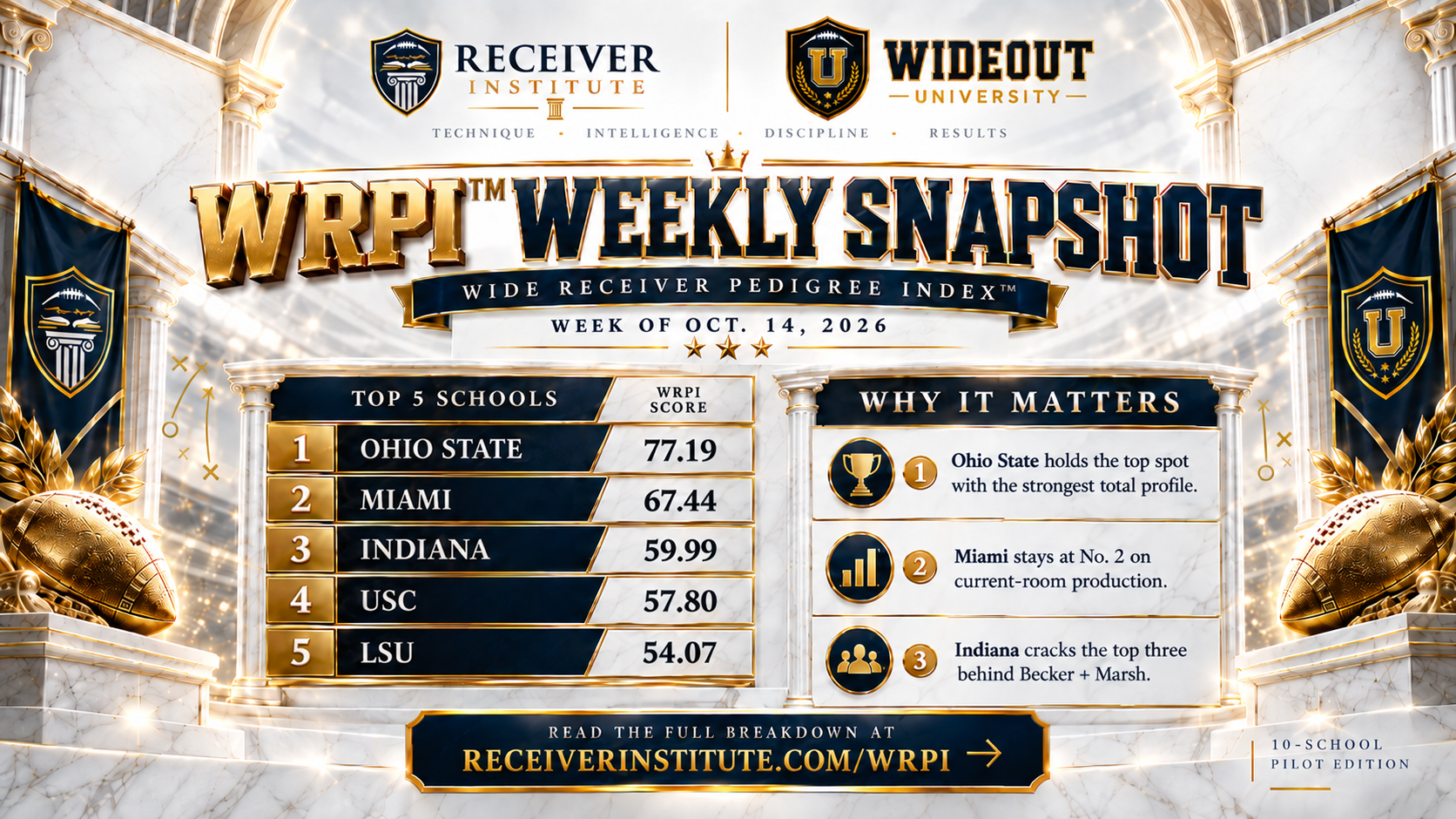
The five leading schools in our inaugural pilot and three early storylines emerging from the rankings.
This Is Just the Beginning
Receiver Institute was founded on a belief that the wide receiver position deserves a dedicated platform for its development, its community and its history.
From high school prospects to college standouts, active professionals and retired legends, receivers are connected by a craft that extends well beyond a single season or level of competition.
The WRPI™ is one expression of that philosophy.
A way to celebrate the work being done in receiver rooms across the country.
A way to recognize programs preparing players for success at the next level.
And a way to connect the accomplishments of today's receivers to those who helped define the position before them.
We're starting with ten programs.
We intend to build from there, with refreshed rankings, deeper school profiles, continued analysis, and additional programs entering the comparison as the WRPI™ evolves.
And we want the football community involved.
Which program deserves to be added to the next WRPI™ evaluation?
Which receiver room isn't getting enough respect?
And what should matter most when we talk about Wideout University?
Those are conversations worth having.
We'll bring the data.
You bring the debate.
Explore the WRPI™
See the complete rankings, school-by-school breakdowns, current receiver contributors, NFL alumni and scoring methodology on the interactive WRPI™ dashboard.
Receiver Institute | Wideout University
Once a receiver, always a receiver.
Methodology note: Inaugural pilot scores are based on the October 14, 2026 data refresh. College statistics include games through October 10, NFL performance through October 12, and roster information through October 14. College scores are benchmarked against the ten selected pilot programs rather than the full FBS. The college scoring formula remains the pilot methodology pending final confirmation.